
Leadership · Portfolio Management · Strategy Execution
Why Executives Still Struggle to See What’s Happening Across Their Projects
Executives may have project reports from every department and still struggle to see what needs attention. The problem is often not a missing dashboard. It is inconsistent ownership, risk reporting and project updates across teams.
Consider a hypothetical regional operations team overseeing 25 projects in Singapore, Malaysia and Thailand. At Friday's meeting, most projects show green. Yet a critical approval is overdue, the same specialist is assigned to two launches, and one project has not been updated for ten days.
Nobody deliberately concealed the problems. Each team simply reports progress differently. Leadership cannot act on a risk it cannot see clearly.
What should an executive project view actually show?
Executives rarely need every task. They need reliable answers to a smaller set of management questions:
- Health: Which initiatives are on track, at risk or off track—and why?
- Ownership: Who is responsible for each project and the next decision?
- Delivery: Which milestones and dependencies threaten the schedule?
- Capacity: Where are teams or key specialists overloaded?
- Action: What needs management intervention this week?
A portfolio full of green status indicators is not useful if the underlying updates are stale or nobody has recorded the blocked decisions.
Where Asana Portfolios fit
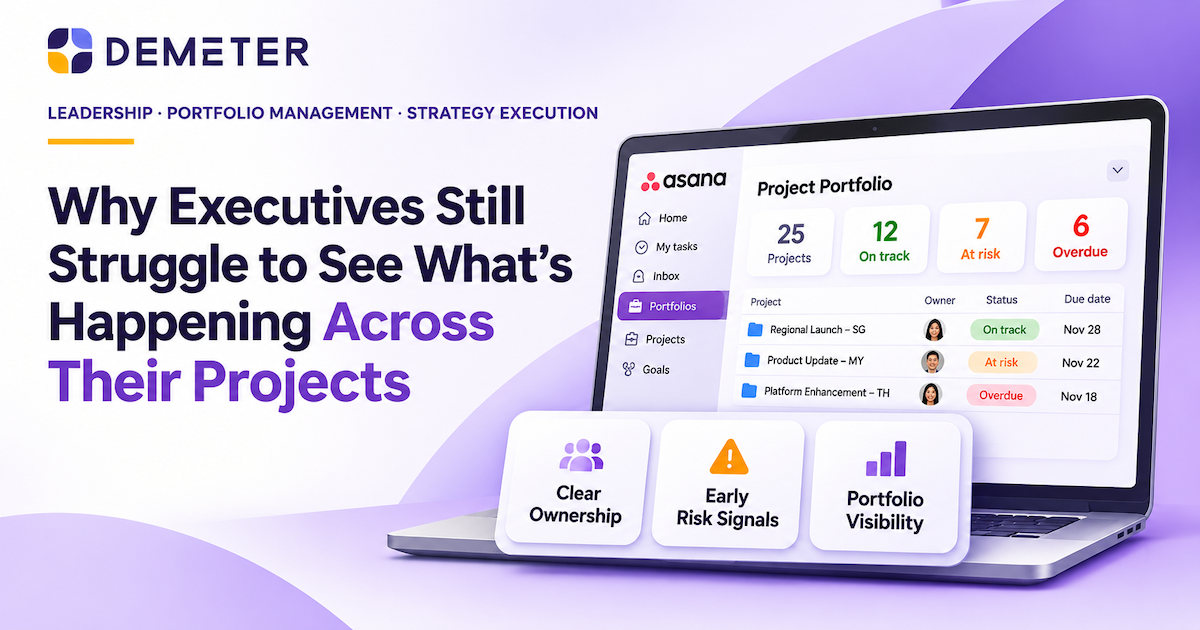
Asana Portfolios can bring related projects into one place and show owners, status, dates and progress. Portfolio dashboards can summarize work across those projects, while status updates add context explaining what has happened and what needs attention.
For a regional leadership team, a portfolio might include a product launch, a CRM rollout, a service transformation and a compliance initiative. Each project has its own delivery team, but leaders can review their status using a shared management structure rather than compiling unrelated slide decks.

The reporting process matters more than the dashboard
Asana displays information based on work and updates captured by the team. To make an executive view trustworthy, organizations need clear operating rules before configuring charts. This is why Asana implementation and workflow consulting should address project governance as well as dashboard configuration:
- Name one accountable project owner. Responsibility for the project status must be clear.
- Agree on status definitions. “At risk” should have a comparable meaning across departments.
- Set an update cadence. Require meaningful weekly or milestone-based updates, not only changes to a percentage.
- Standardize essential fields. Use consistent dates, priorities, teams and escalation information.
- Act on exceptions. Record the decision, owner and next step when a risk appears.
Task completion is not business impact. A project may reach 100% completion while the intended improvement in revenue, adoption or customer satisfaction remains unproven. Delivery progress and business KPIs should be reviewed separately, with the appropriate systems used to verify outcomes. Connecting projects to company goals and OKRs in Asana can make that distinction more visible, but the underlying key results still require reliable measures.
From collecting status reports to managing exceptions
A practical executive review spends less time assembling slides and more time making decisions. Consider the difference:
| Traditional reporting | Better management practice |
|---|---|
| Every department prepares a different slide deck | Project owners follow a consistent update format |
| “On track” without explanation | Status includes risks, blockers and corrective action |
| Escalation happens at the monthly meeting | Critical blockers are raised when they occur |
| Leadership reviews task counts | Leadership prioritizes exceptions and decisions |
Asana's portfolio progress and reporting can support this process when the project information is maintained. Portfolio dashboards do not independently verify what is happening outside Asana, and permissions can affect what each viewer sees.
When workload is the real problem
Sometimes a project is at risk not because the project plan is wrong, but because the same people are committed to several initiatives. Where available and appropriately configured, Asana's Workload views can help managers assess assignments and spot potential capacity conflicts.
They are useful management signals—not a replacement for accurate effort estimates or resource planning. Portfolio, workload and advanced reporting availability depends on the Asana subscription plan.
What a useful weekly executive project update looks like
For a leadership review, each project owner should give decision-ready information rather than simply reporting that tasks are moving. A consistent update can be short:
Illustrative project: Regional CRM Rollout
- Overall status: At risk — Malaysia pilot depends on an outstanding data-privacy review.
- Milestone: Pilot sign-off due next Friday; local testing is complete.
- Decision needed: Approve the revised testing sequence by Wednesday.
- Accountable owner: Regional CRM Program Manager.
- Next update: After the approval decision, or sooner if the risk changes.
That is more actionable than a green progress bar. It identifies what changed, who owns the risk, and what leadership must decide.
How to structure an Asana executive portfolio
A practical Asana portfolio starts with a defined group of projects and common reporting rules. For example, an APAC transformation portfolio could include initiatives across Singapore, Malaysia and Thailand while using the same status vocabulary.
- Decide what belongs in the portfolio. Include projects relevant to the decision-making group; do not combine unrelated operational tasks simply to create a bigger dashboard.
- Agree on a minimum reporting standard. Project owner, current health, next milestone, relevant risk, and decision requested are often a useful baseline.
- Configure views around decisions. Use status and due-date views to identify projects needing action; add fields only where they help management.
- Establish update and escalation rules. Routine updates may be weekly, but critical risks should not wait for the next scheduled review.
- Check the source information. Validate status updates against actual project evidence and the responsible owner before using them to make commitments.
Asana can display data that is captured and maintained in the workspace. It does not independently validate external milestones, financial outcomes or unrecorded decisions. Portfolio and workload features also depend on the selected plan and access rights.
Executive visibility with Asana: common questions
Can executives see progress across multiple Asana projects?
Yes. Asana Portfolios can bring related projects together so authorized users can review project owners, dates, progress and status. The quality of that overview depends on how consistently teams report and maintain project information.
Does an Asana dashboard automatically detect delayed projects?
Not reliably on its own. Dashboards reflect recorded tasks, dates and status updates. If a blocker is not captured or a project owner does not update the status, the dashboard may not show the operational risk.
What is the difference between project progress and business results?
Project progress describes delivery activity, such as completed tasks or milestones. Business results measure outcomes, such as revenue, retention or adoption. They should be monitored separately using trustworthy business data, even when goals and projects are linked.
What should an organization improve before creating an executive dashboard?
Start with clear project ownership, comparable status definitions, a regular update cadence, escalation rules and a manageable set of reporting fields. Then configure the portfolio views around the decisions leaders need to make.
How DEMETER helps organizations already using Asana
For an existing Asana customer, our Asana consulting and implementation service starts not with another dashboard, but with the management decisions that matter. We assess whether the existing workspace provides information that supports those decisions.
- Assess: Review current portfolios, workflows, project ownership and reporting gaps.
- Prioritize: Define the management questions, exceptions and escalations that matter.
- Improve: Configure agreed fields, status conventions, portfolio views and handoffs.
- Validate: Test the results with actual project owners and management stakeholders.
- Enable: Help teams maintain the reporting practices that make the information useful.
Many organizations can improve an existing Asana environment without rebuilding everything. The recommended scope depends on how that workspace is configured today.
A better question for your next project review
Instead of asking, “Can we see all projects on one dashboard?”, ask “Can we identify which project needs a decision this week—and trust the information behind it?”
That is the real purpose of executive visibility: less time chasing updates, more time resolving issues that affect delivery.
Already using Asana but struggling with project visibility?
DEMETER ICT helps APAC organizations assess existing Asana workspaces, improve portfolio reporting and implement practical management workflows. Start with a conversation about the problems your team is facing.
Discuss Your Asana Workspace on WhatsApp