
Why OKRs Fail After Planning — and How to Make Them Work in Practice
Many organizations agree on objectives and key results, then struggle to connect them with what teams actually do. A useful OKR system links goals to accountable initiatives, reliable measures and management decisions—not just a quarterly spreadsheet.
Every quarter, leadership teams define objectives, agree on key results and align departmental priorities. The workshop goes well. The OKR document is approved. Then everyone returns to daily work.
Marketing launches campaigns. Customer service improves its processes. Operations completes projects. Yet during the next management review, leadership still struggles to answer one question: Are these activities actually moving the company's key results?
An effective OKR management system helps answer that question with measurable outcomes, clear ownership, connected work and decisions that keep execution on course.
Why do OKRs fail after the planning workshop?
OKRs become ineffective when they are treated as a planning deliverable rather than an ongoing way to manage priorities and results. Five failures are particularly common:
- Unclear accountability: Several teams contribute to an outcome, but no one owns the measure or the explanation of results.
- Disconnected projects: Teams complete work without showing which strategic outcomes it supports.
- Inconsistent measurements: Different departments use different metric definitions, periods or data sources.
- Irregular reviews: Goals are revisited only when quarterly reporting is due.
- No corrective decisions: A key result falls behind, but the meeting ends with a status update rather than action.
The test of an OKR program is not whether the company has written its goals. It is whether those goals change what people prioritize, measure and decide.
What makes OKRs a real management system?
A practical OKR operating model needs five linked elements: clear objectives, measurable key results, supporting initiatives, reliable progress reporting and management decisions.
- Objectives: Define the important outcomes the organization wants to achieve.
- Key results: Establish baseline, target, metric definition, reporting period and an accountable owner.
- Initiatives: Identify the projects and process improvements expected to influence those results.
- Reporting: Update outcomes and execution status using consistent definitions and trusted information.
- Decisions: Address constraints, revise assumptions and assign corrective actions when results are behind.
Without the final element, OKRs risk becoming another reporting exercise.
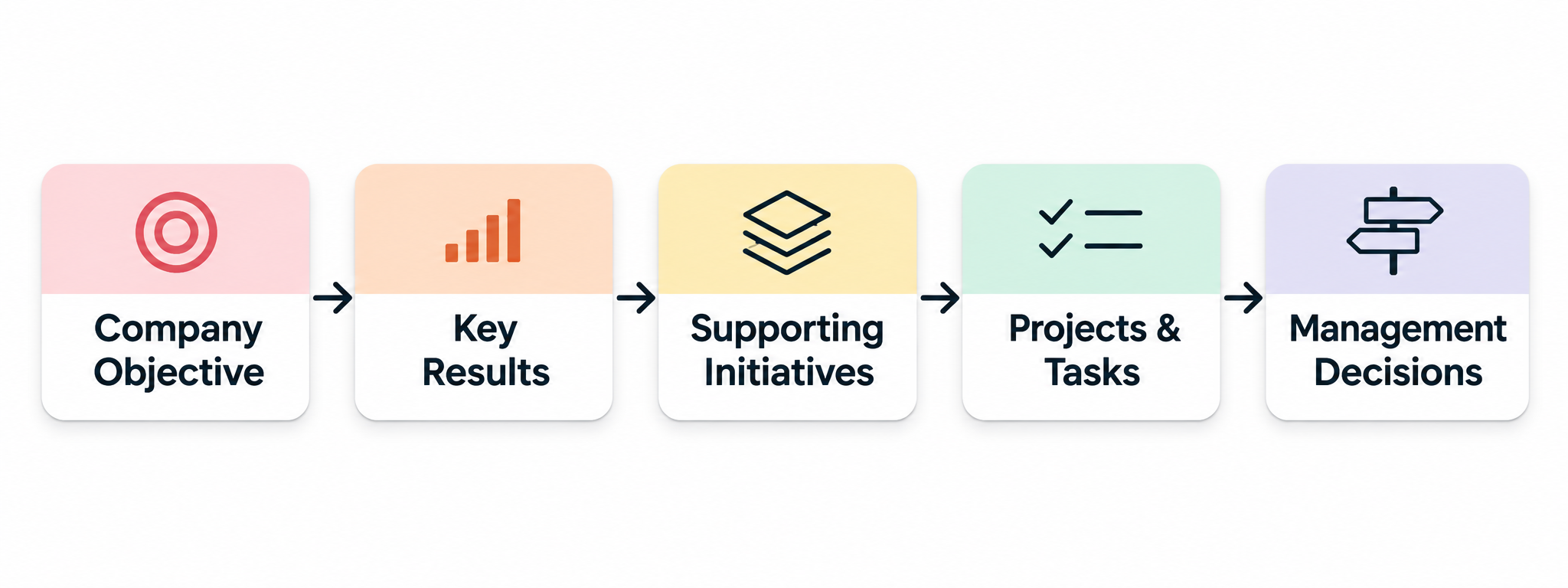
A practical OKR example: Improving customer retention across Southeast Asia
Consider a hypothetical regional service company operating in Singapore, Malaysia and Thailand. Leadership wants to improve retention during customers' early months with the service.
Objective: Improve customer retention across Southeast Asia
| Key result | Baseline | Target |
|---|---|---|
| Increase customer retention rate | 82% | 88% |
| Reduce average time to first value | 21 days | 14 days |
To support these outcomes, teams agree on three initiatives:
| Initiative | Responsible team | Expected contribution |
|---|---|---|
| Customer onboarding redesign | Customer Success | Help new customers realize value sooner |
| Service process improvement | Operations | Reduce recurring delays and service problems |
| Proactive customer engagement | Customer Success & Marketing | Identify and address disengagement earlier |
Illustrative figures and initiatives. These are not DEMETER customer results.
Why project completion is not the same as OKR success
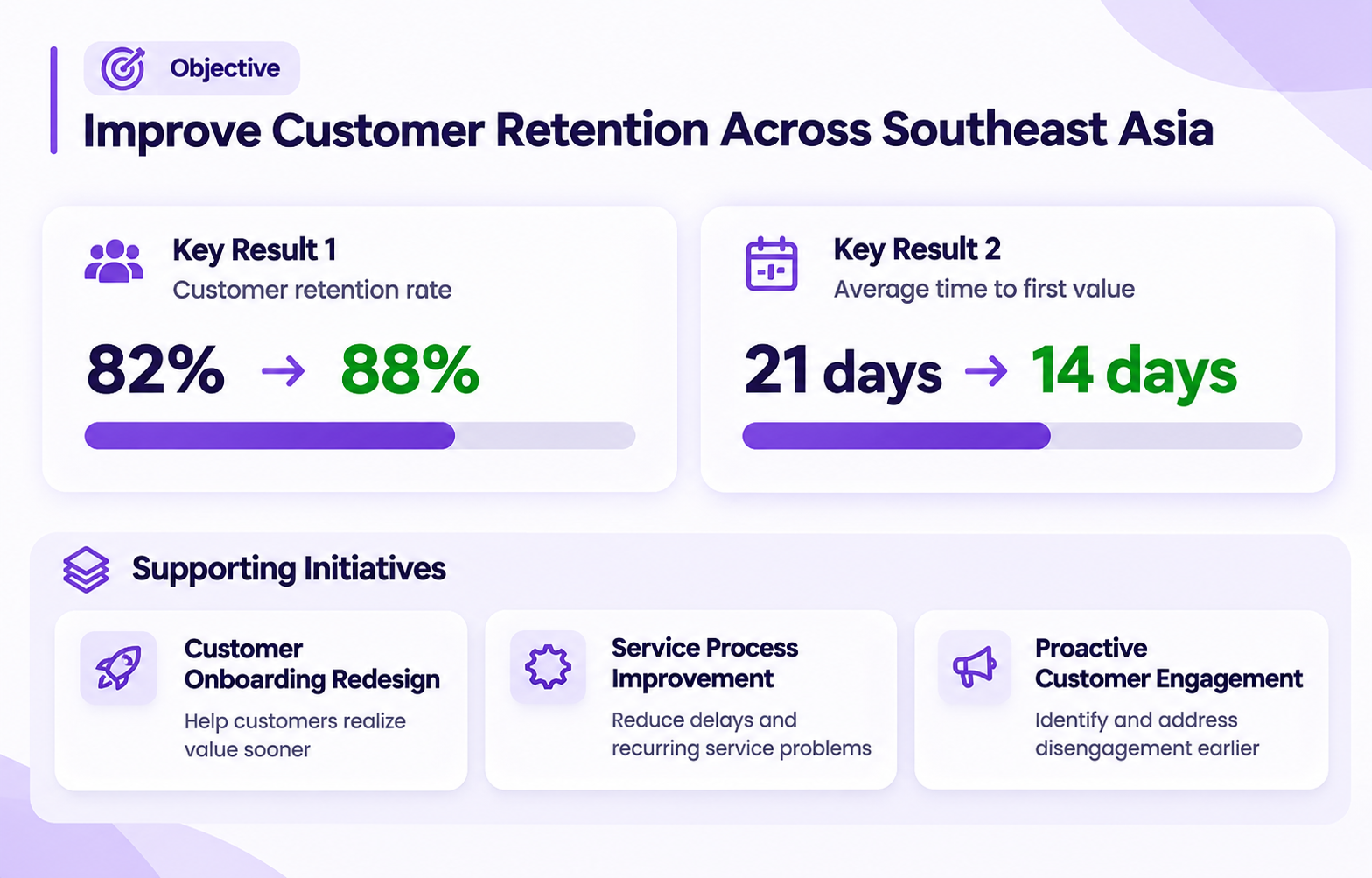
Imagine the onboarding redesign project is 90% complete. Testing is nearly finished and the team expects to launch the last changes soon. That is useful delivery information.
But customer retention has only moved from 82% to 83.5%, while average time to first value remains at 18 days. The intended outcomes have not yet been achieved.
Leadership should investigate whether customers are receiving value sooner, whether the changes reach the relevant segments and whether churn is driven by onboarding, product fit, service quality or something else.
A completed project is evidence that work was delivered. It does not automatically prove that the business result was achieved. That is why a useful OKR review must show initiative progress and key result performance separately.
What should executives review during an OKR meeting?
Executives need enough information to make decisions, not simply a wall of green and red status indicators. A mid-quarter review might look like this:
| Management measure | Current position | Decision needed |
|---|---|---|
| Customer retention | 83.5%; target 88% | Investigate churn by segment and driver |
| Time to first value | 18 days; target 14 | Remove onboarding bottlenecks |
| Onboarding redesign | 90% complete | Verify impact on customer outcomes |
| Service improvement | At risk | Resolve ownership and resource constraints |
A good review answers four questions: Are the key results moving? Is the supporting work progressing? What explains the gap? What decision is required?
For many organizations, weekly or biweekly goal-owner check-ins and monthly management reviews are practical. Choose the frequency according to how often a metric can be measured reliably; do not demand weekly updates to a measure that is only meaningful monthly.
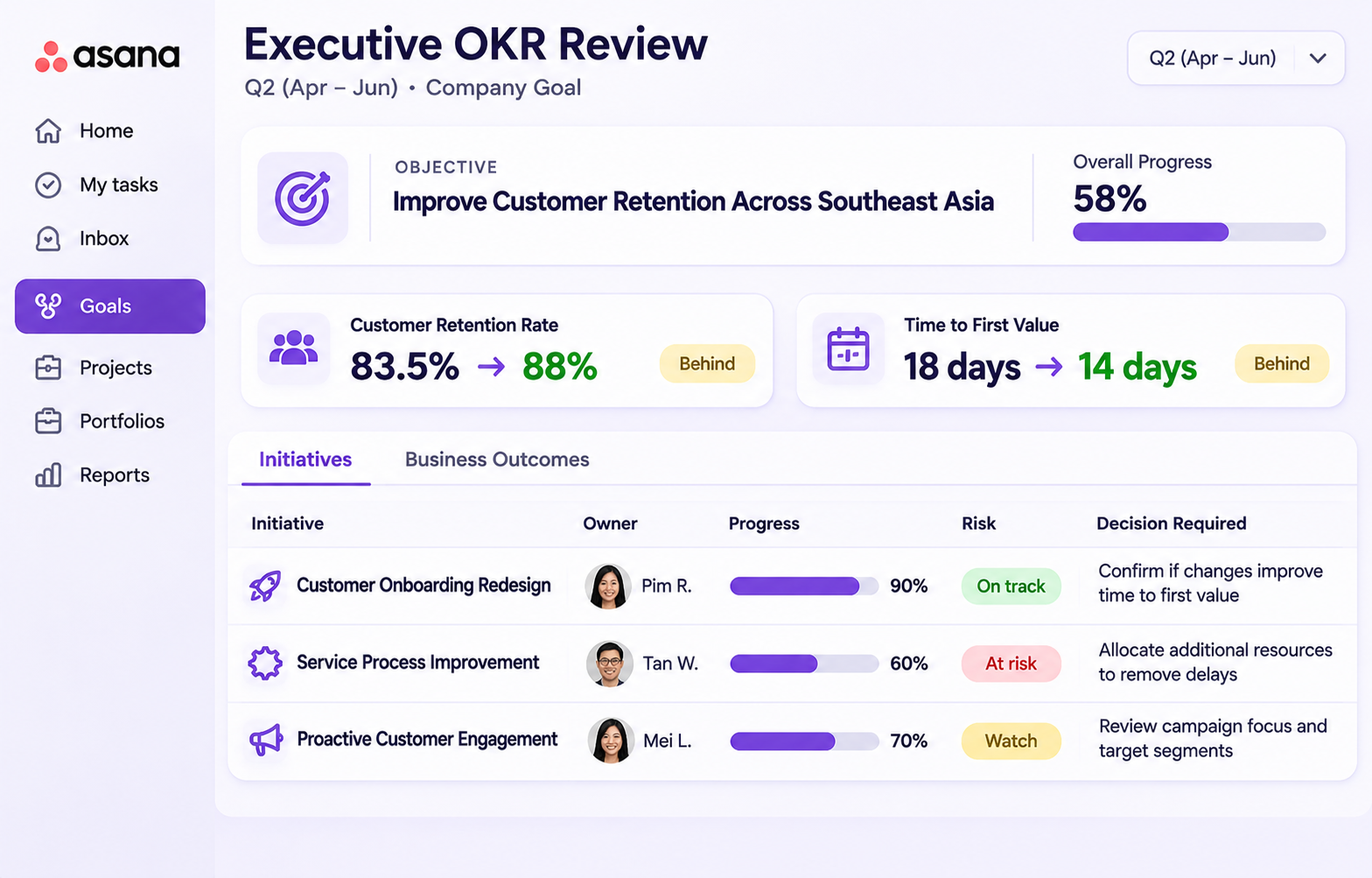
How do you connect company OKRs to department execution?
The relationship should be explicit without becoming a complex bureaucracy:
In our example, Customer Success coordinates the retention outcome and onboarding work, Operations addresses service delays, and Marketing supports customer engagement.
One owner remains responsible for explaining the goal's progress and escalating decisions, even when several departments contribute. The structure makes it clear why work is being done and how it is expected to influence the result.
How does Asana support OKR management and strategy execution?
Asana work management can connect company and team goals with the projects and tasks intended to support them.
Goal alignment and accountability
Asana Goals supports company and team goals and named owners, making strategic priorities easier to follow across departments.
Connecting initiatives with execution
Relevant projects and tasks can be linked to goals. Leaders can move from a company objective to the supporting work without maintaining separate disconnected project lists.
Progress updates versus business measures
Asana supports manually updated goals and automatic progress calculations from configured supporting work in applicable configurations. But completing tasks does not automatically verify revenue, retention or satisfaction results. Those outcomes require reliable metrics, data owners and appropriate update methods.
Executive visibility
Goal progress and supporting project information can help leaders identify priorities requiring attention. The quality of that view depends on consistent work updates, trusted metric sources and the features available in the organization's subscription.
For the platform and implementation approach, explore Asana for Enterprise OKR & Goal Management.
Where do organizations get OKR implementation wrong?
Building a goal hierarchy before agreeing on ownership
Software can represent company and team goals, but the organization must decide who owns each measure, supplies data and resolves competing priorities first.
Turning every task into an OKR
Routine operations, compliance and ongoing responsibilities are important even if they are not strategic initiatives. Connect work to objectives when the relationship is meaningful rather than forcing every task into an OKR.
Automating reporting before defining measures
Before automating updates, agree on metric definitions, systems of record, accountable owners and reporting frequency. Otherwise the dashboard can look polished while conveying inconsistent information.
How DEMETER ICT helps organizations implement OKR management with Asana
Practical OKR implementation combines management-process design with platform configuration. DEMETER can help define goal hierarchies, Key Result ownership, project links and review practices, then configure the agreed workflows in Asana.
Organizations introducing a goal-management approach can explore our Asana OKR & Goal Management consulting.
Already using Asana? Our Asana Consulting & Implementation Services can assess the existing workspace and recommend targeted improvements without automatically rebuilding what works.
The consulting scope starts with how the organization measures results, coordinates work and makes decisions—not a list of software features.
Frequently asked questions about OKR management
Why do OKRs fail after planning?
OKRs often lose effectiveness when objectives are not connected to accountable initiatives, reliable measurements, and regular management reviews. Teams may finish projects without verifying whether those projects improved the intended business outcomes.
What is the difference between OKRs and KPIs?
KPIs track ongoing business performance. OKRs define priority changes an organization wants to achieve in a defined period. The same retention metric can be a KPI, while increasing retention from 82% to 88% can be a Key Result.
How often should OKRs be reviewed?
Choose a cadence that matches the measures. Weekly or biweekly goal-owner check-ins can support monthly management reviews and quarterly planning. Reviews should identify decisions and actions, not merely request status updates.
Can Asana manage company-wide OKRs?
Yes. Asana Goals can organize company and team goals, owners, progress, and supporting work. Available capabilities depend on the subscription plan and configuration.
Does Asana automatically update Key Results?
Asana can calculate some goal progress from configured supporting work and supports manual updates. Outcomes such as retention or revenue still require reliable business metrics and appropriately configured data updates. Completed tasks do not automatically prove a business outcome.
Can Asana replace Excel or a BI system for OKR management?
Asana can connect goals, accountability, and projects in a shared workspace. ERP, CRM, finance, and BI systems may still be necessary as trusted sources of operational and financial measures.
Can DEMETER help if our organization already uses Asana?
Yes. DEMETER provides consulting for existing Asana environments, including goal design, workflow optimization, reporting improvements, and adoption. An engagement need not involve rebuilding the workspace.
Make OKRs part of management, not just planning
A useful OKR program continues after the objectives are approved—with execution, measurement, reviews and decisions. If your organization needs to connect goals with actual work, DEMETER can help you design a practical approach using Asana.
Discuss Your OKR Implementation