

Marketing Operations · Campaign Management · APAC
Why Marketing Campaigns Get Delayed — Even When Everyone Is Busy
When briefs arrive in chat, feedback lives in email and approvals are scattered across teams, campaign delays become difficult to prevent. Here is how marketing managers can fix the workflow—not simply ask everyone to work faster.
Quick answer
Why do marketing campaigns get delayed? Common causes include incomplete briefs, unclear ownership, approval bottlenecks, changing requirements and dependencies between teams. A structured marketing campaign workflow makes requests, responsibilities, review decisions and deadlines visible in one place. Tools such as Asana can support this process, but the workflow must be designed first.
A campaign can look busy without moving closer to launch. Designers are producing assets, content writers are preparing copy, and digital marketers are arranging media plans. Yet a landing page is waiting for final text, an advertisement needs approval, and a product manager has requested another change.
For a marketing manager, the problem is not necessarily poor individual performance. It is the time lost between one person's work and the next person's decision.
1. Why do marketing campaigns get delayed?
Four operational problems appear repeatedly in campaign delivery. They are particularly noticeable when internal teams, external agencies and regional stakeholders work together.
Briefs arrive everywhere
New requests appear in email, chat, meetings and spreadsheets. The team lacks a consistent brief and cannot easily compare priorities.
Task ownership is unclear
An asset may be finished but not handed over. Everyone assumes that someone else will request the next approval.
Feedback is fragmented
Comments arrive on different versions of the same design. It becomes difficult to identify the feedback that should guide the final revision.
Dependencies surface late
Media booking, translation or web development may be blocked until another team delivers an approved item.

Another status meeting may temporarily uncover these issues. But meetings alone do not establish a reliable process for the next campaign.
2. Example: one regional campaign, five teams
Consider a hypothetical regional marketing team launching a promotion in Singapore, Malaysia and Thailand. The work involves marketing, design, web development, legal or brand review, and digital advertising—similar to the cross-team campaign coordination challenges faced by advertising agencies.
| Stage | Responsible team | Typical delay |
|---|---|---|
| Campaign brief | Marketing | Missing requirements or late changes |
| Copy and creative | Content / Design | Conflicting revisions and priorities |
| Landing page | Web team | Waiting for approved assets and text |
| Final review | Brand / Legal / Management | Unclear reviewer or approval deadline |
| Go-live | Digital marketing | Dependencies discovered just before launch |
Each team may be delivering its own tasks. The campaign is still late because the handoffs between teams are not managed as one workflow. A useful system must reveal the blocker, responsible person and next action—not merely show a long checklist.
This is an illustrative example, not a reported DEMETER customer result.
3. What does a better marketing campaign workflow look like?
A practical workflow should answer: What was requested? Who owns the next step? What is waiting for approval? What must finish before launch?
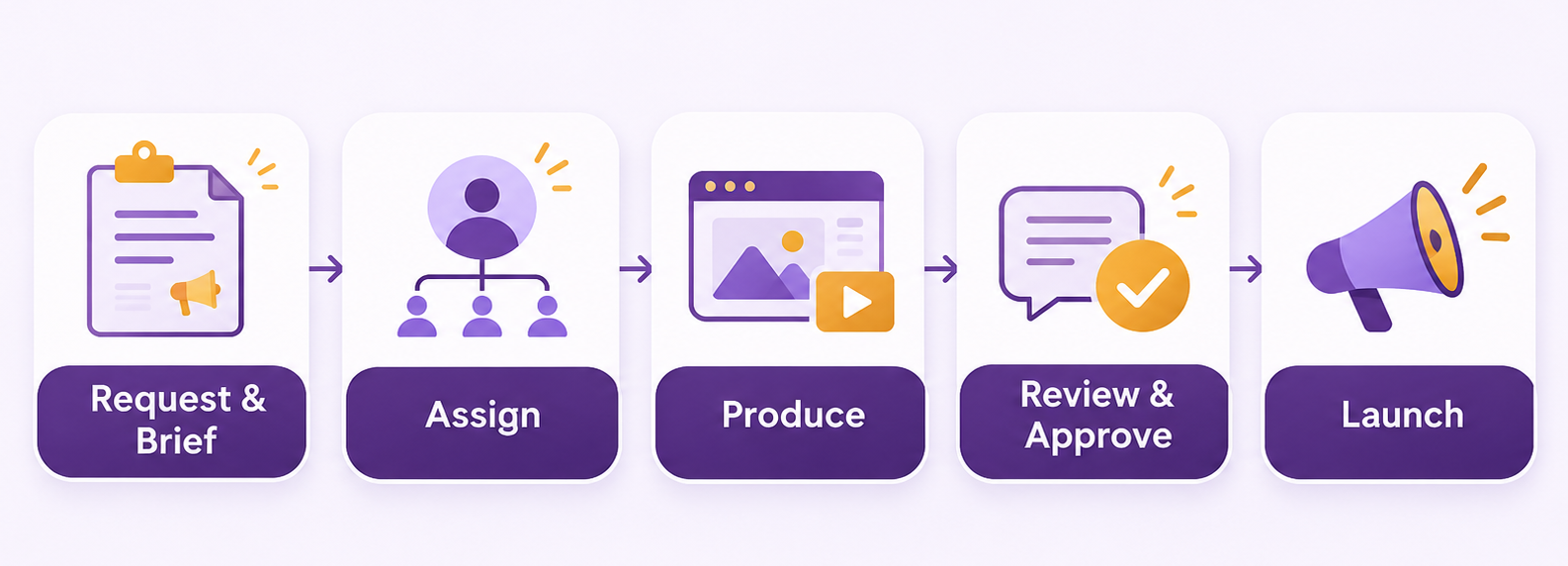
The goal is not to add administrative steps. It is to remove uncertainty that causes unnecessary follow-ups and rework.
4. How can Asana help manage marketing campaigns?
Asana is a work management platform that can coordinate campaign tasks, owners, deadlines, dependencies and approval steps. It does not replace your creative software or advertising platforms; it helps teams coordinate the work around them.
| Operational problem | Relevant Asana capability |
|---|---|
| Incomplete or scattered briefs | Forms and project intake |
| Repeated campaign setup | Reusable projects and templates |
| Unclear ownership or timing | Task assignees, due dates and dependencies |
| Approval bottlenecks | Approval tasks and feedback tracking |
| Manual handoffs | Configurable Rules for supported workflow steps |
| Difficulty seeing upcoming work | Project list, board, calendar and timeline views |
For example, submitting a creative-request form can create a task in an Asana project. The team can then review the brief, assign an owner, track production and request approval. Rules can automate selected steps when explicitly configured; Asana does not automatically understand every business process or resolve approval delays on its own.
Feature availability and configuration vary by Asana plan. Teams should confirm their subscription and workflow requirements before implementation.
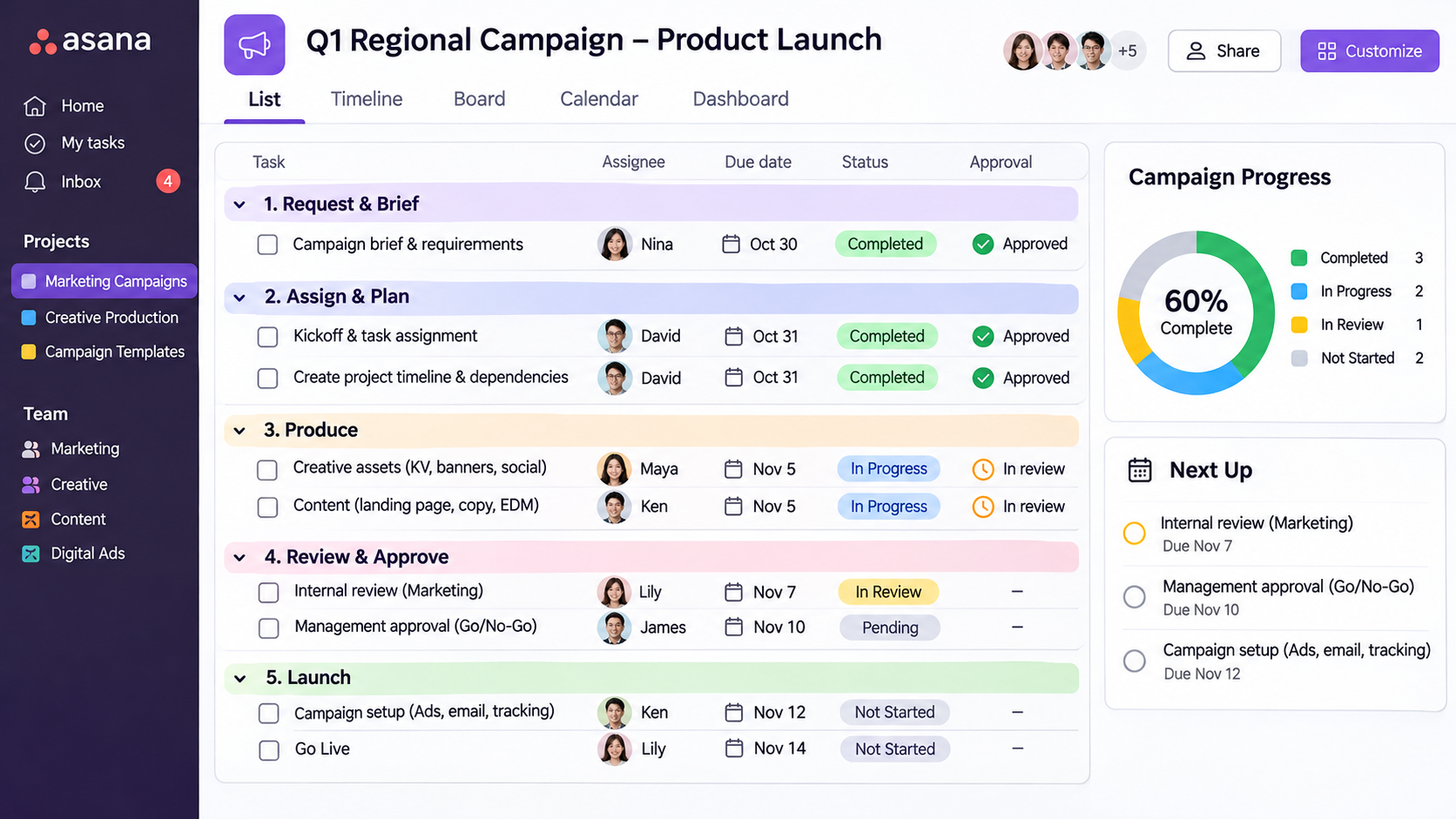
For a related industry-specific example, see Asana for Advertising Agencies.
5. How should a small marketing team get started?
Start with one recurring workflow rather than migrating every task into a new platform.
- Choose one use case. Creative requests, campaign approvals or regional launch coordination are useful candidates.
- Map the current process. Identify request sources, approval gates, owners and recurring delays.
- Define a minimum workable workflow. Agree on stages, required brief fields, assignment rules and review responsibilities.
- Build and test. Configure one Asana project and run a real or representative campaign through it.
- Review and adjust. Ask users what still requires unnecessary messages, meetings or manual status collection.
A limited pilot keeps the implementation manageable and helps the team establish consistent habits before expanding across departments or markets.
7. What business value can a better marketing workflow create?
The value of structured campaign management is not the number of tasks recorded in a tool. It is the improvement in how predictably and efficiently campaigns are delivered.
| Operational improvement | Potential business value | How to check |
|---|---|---|
| Faster approvals | Shorter campaign lead time | Measure request-to-approval time |
| Fewer revision cycles | Less creative production rework | Track rounds of changes per asset |
| Clear task ownership | Lower coordination overhead | Sample time spent on follow-ups |
| Better dependency visibility | More predictable launch dates | Compare planned versus actual launch |
| Reusable campaign templates | Less setup effort on recurring work | Track preparation time per campaign |
A marketing team may see gains in speed and consistency before it sees a direct effect on sales. That is why operational indicators and business outcomes should be reviewed separately.
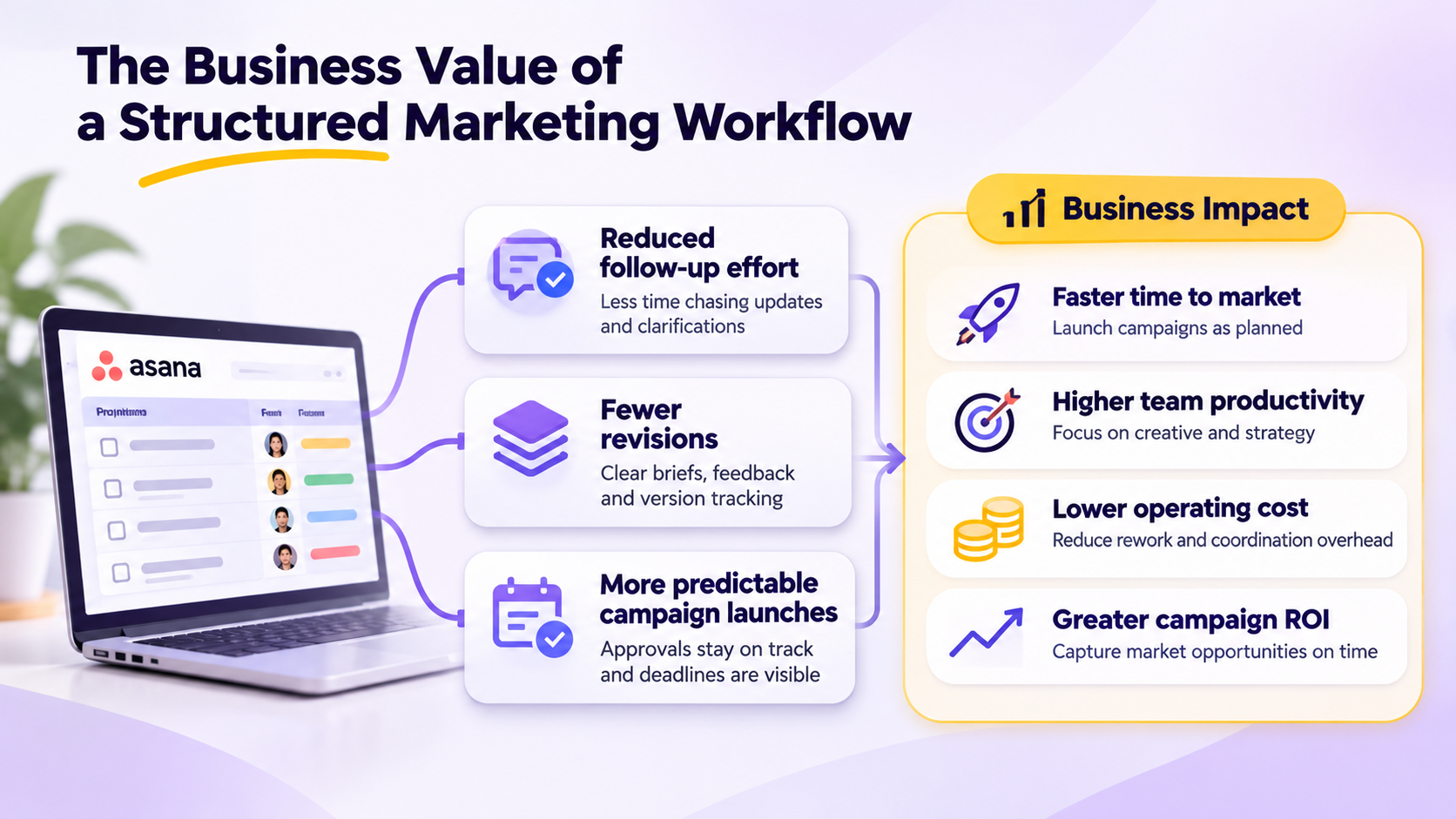
8. Is Asana worth the investment for a marketing team?
It can be, if the time and coordination problems are large enough to justify the subscription, implementation and adoption effort. A simple business case helps a team evaluate that before buying more software.
An illustrative capacity-value calculation
Suppose a 10-person marketing team could reduce time spent chasing status updates, clarifying handoffs and coordinating approvals by two hours per person per week. Assume an illustrative fully loaded labor cost of US$20 per hour.
Important: This represents the estimated value of time that could become available for other work, not automatic cash savings, additional revenue or guaranteed Asana ROI. The assumed improvement must be validated with real baseline and post-implementation measurements.
What costs should be included?
Before deciding, compare the potential operational value against the total cost of Asana licenses, any implementation or consulting services, training and the team's time spent configuring and adopting the process. Consider costs over a defined period, such as 12 months.
One simple decision framework is: potential annual value of measurable improvements minus total annual adoption and operating costs. The result is meaningful only when assumptions are evidence-based and the value of released time is not mistaken for actual budget reduction.
For a small team, a single campaign or creative-request workflow is a sensible pilot. Establish the starting approval time, coordination effort and delivery reliability; test the revised process; then decide whether a wider rollout is justified.
9. How do you know whether the workflow is improving?
Completed tasks are not enough. Measure whether the process is becoming more predictable and easier to manage.
| Metric | Why it matters |
|---|---|
| Request-to-assignment time | Shows how long new requests wait before someone takes ownership. |
| Approval turnaround time | Highlights review queues and slow decisions. |
| On-time deliverable rate | Tests whether promised delivery dates are becoming more reliable. |
| Revision cycles | Helps identify repeated rework and unclear briefs. |
| Overdue or blocked tasks | Shows where managers need to intervene. |
For business-value assessment, also sample weekly hours spent chasing updates and preparing status reports. Compare before-and-after results using a similar mix of campaign types and workload.
Record a baseline before changing the process. Do not assume that using Asana automatically improves these measures; results depend on the workflow design, data quality and adoption.
10. How DEMETER ICT helps marketing teams implement Asana
DEMETER ICT supports teams across APAC with Asana licensing, workflow consulting, implementation and practical training. We focus on the business process before deciding which features to configure.
For a marketing team, this may mean defining a campaign brief, mapping review responsibilities, building a reusable campaign project template, configuring agreed workflow rules and helping staff use the process consistently.
Teams that already have Asana can also engage DEMETER for an existing-workspace review or workflow optimization. A full rollout is not required for every engagement.
Frequently asked questions about marketing workflow management
What is the main cause of marketing campaign delays?
There is rarely one cause. Common operational sources include incomplete briefs, unclear ownership, late approvals and dependencies between teams. Reviewing where work waits between steps is a useful starting point.
Can Asana manage campaign approvals?
Yes. Asana supports campaign approval workflows and review tasks. The team still needs to define who has approval authority, what is being approved and when a decision is required.
Can Asana replace email or creative software?
No. Teams may continue using email, design applications and advertising platforms. Asana is used to coordinate requests, tasks, decisions and deadlines across those tools.
Is Asana suitable for small marketing teams and creative agencies?
It can be, especially when several people collaborate on recurring campaigns, creative requests and client approvals. The value depends more on coordination complexity than company size.
Do we need to redesign every campaign process before using Asana?
No. Start with one repeatable workflow, test it with users and expand only after the process is working reliably.
How can we estimate whether Asana will be worth the cost?
Measure current coordination time, approval delays and rework. Estimate the value of realistic improvements and compare it with licensing, implementation, training and adoption costs. Released staff time is capacity, not necessarily cash savings.
Can DEMETER help if our team already uses Asana?
Yes. DEMETER ICT offers consulting and implementation services for existing Asana workspaces, including workflow reviews, configuration improvements and training under an agreed scope.
Start with one workflow
Still managing campaign requests through email, chat and spreadsheets?
Tell DEMETER ICT where your marketing workflow gets stuck. We can discuss a practical starting point for campaign intake, creative production or approvals in Asana.
Discuss Your Workflow on WhatsAppRelated DEMETER services: Asana Services · Asana for Agencies · Asana Consulting & Implementation