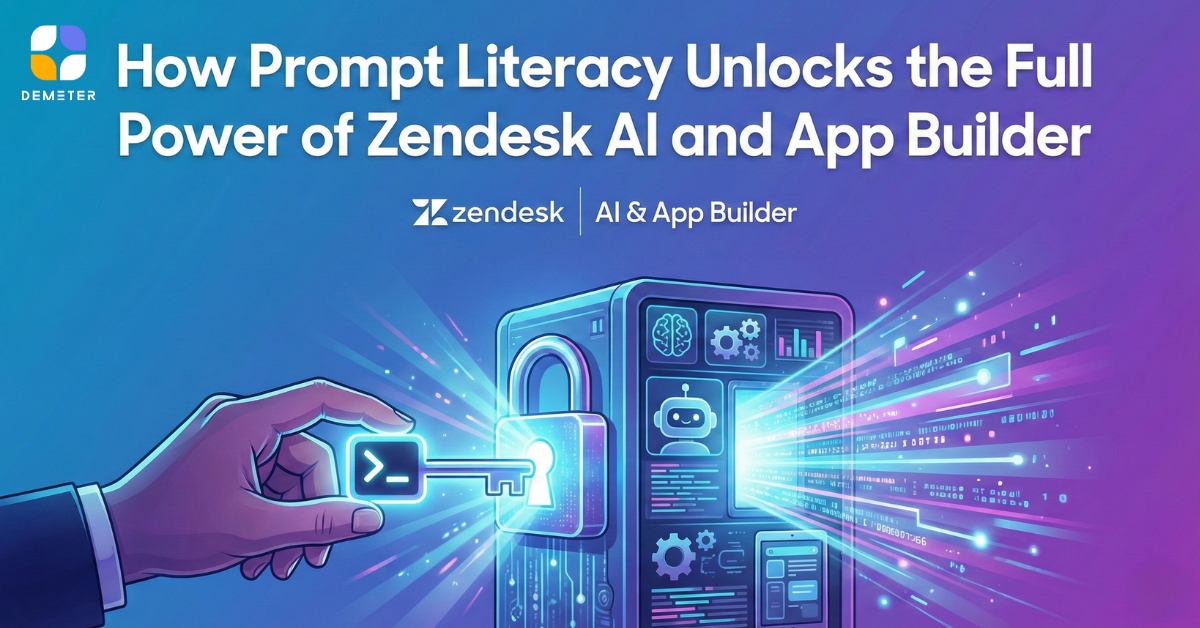
Prompt Literacy: The New Essential Skill for Modern CX Teams
Customer experience is entering a new phase—one where AI doesn’t just assist behind the scenes, but actively shapes how service is delivered. As Zendesk introduces powerful tools like App Builder and generative AI–driven workflows, one skill is quickly becoming critical for CX leaders and teams alike: prompt literacy.
Prompt literacy isn’t about knowing how to “talk to AI” casually. It’s about clearly translating business intent, customer context, and operational rules into instructions that AI can reliably execute. In many ways, prompts are becoming the new interface between people, systems, and automation.
Why Prompt Literacy Matters More Than Ever
Traditional automation relied on predefined flows, rigid rules, and extensive development cycles. While effective for simple use cases, these approaches struggled with nuance, edge cases, and evolving customer needs.
AI-powered tools change that—but only if they’re guided properly.
Well-structured prompts allow AI to:
- Understand customer intent more accurately
- Reason through multi-step workflows
- Adapt responses based on context
- Take action across systems, not just answer questions
Without prompt literacy, even the most advanced AI tools risk producing inconsistent, incomplete, or misleading outcomes. With it, CX teams can move faster, automate more, and still maintain control over quality.
From Technical Skill to CX Capability
Prompt literacy is no longer just a concern for developers or data teams. In a Zendesk environment, it directly impacts:
- How AI agents handle conversations
- How workflows are triggered and executed
- How apps interact with external systems
- How consistently service standards are enforced
As Zendesk App Builder lowers the barrier to creating custom apps, CX, IT, and operations teams are increasingly involved in shaping AI behavior. This shift turns prompt writing into a strategic CX capability, not a technical afterthought.
What Makes a High-Quality Prompt?
Effective prompts go beyond simple instructions. They typically include:
- Clear goals (what outcome the AI should drive)
- Context awareness (what information matters in this scenario)
- Constraints and guardrails (what the AI should and shouldn’t do)
- Logical structure that mirrors real service workflows
In Zendesk App Builder, prompts must also account for practical realities—such as limited UI space, user experience clarity, and integration dependencies with systems like CRM, ERP, or order management platforms.
This is where many teams struggle: knowing what they want AI to do is easy; translating that into a reliable, reusable prompt is not.
Prompt Literacy in Action with Zendesk App Builder
Zendesk App Builder enables teams to design AI-powered apps faster than ever, without starting from scratch. But speed doesn’t eliminate complexity.
A well-written App Builder prompt can:
- Guide AI through ticket context and customer history
- Pull data from external systems via APIs
- Present relevant actions to agents at the right moment
- Reduce manual steps while maintaining accuracy
A poorly written prompt, however, can lead to confusion, incorrect data handling, or inconsistent agent experiences.
That’s why prompt literacy is becoming the difference between using AI and using AI well.
Why Work with Us
Even though App Builder dramatically accelerates development, writing effective prompts still requires expertise:
✔ Deep understanding of your workflows
✔ Knowledge of external systems and API integrations
✔ UX structuring within Zendesk’s limited panel space
✔ Rigorous testing, correction, and optimization
Contact DEMETER ICT for a FREE Zendesk Trial & Consultation
We’ll help you explore what Zendesk Apps can do for your business—and even build your first custom app together.
Because the future of CX isn’t just powered by AI.
It’s shaped by how well you guide it.

About the Author
Mr. Carl Aldrich Wang is an International Marketing Specialist at DEMETER ICT, a Premier Partner of Google and Zendesk in the APAC region. DEMETER ICT serves over 4,600 business customers across APAC, including Greater China, with the largest customer base for Google and Zendesk services in the region. His expertise is in customer experience and global digital strategy with work that emphasizes aligning business goals with customer needs, enabling organizations to strengthen engagement, streamline workflows, and drive measurable growth.